
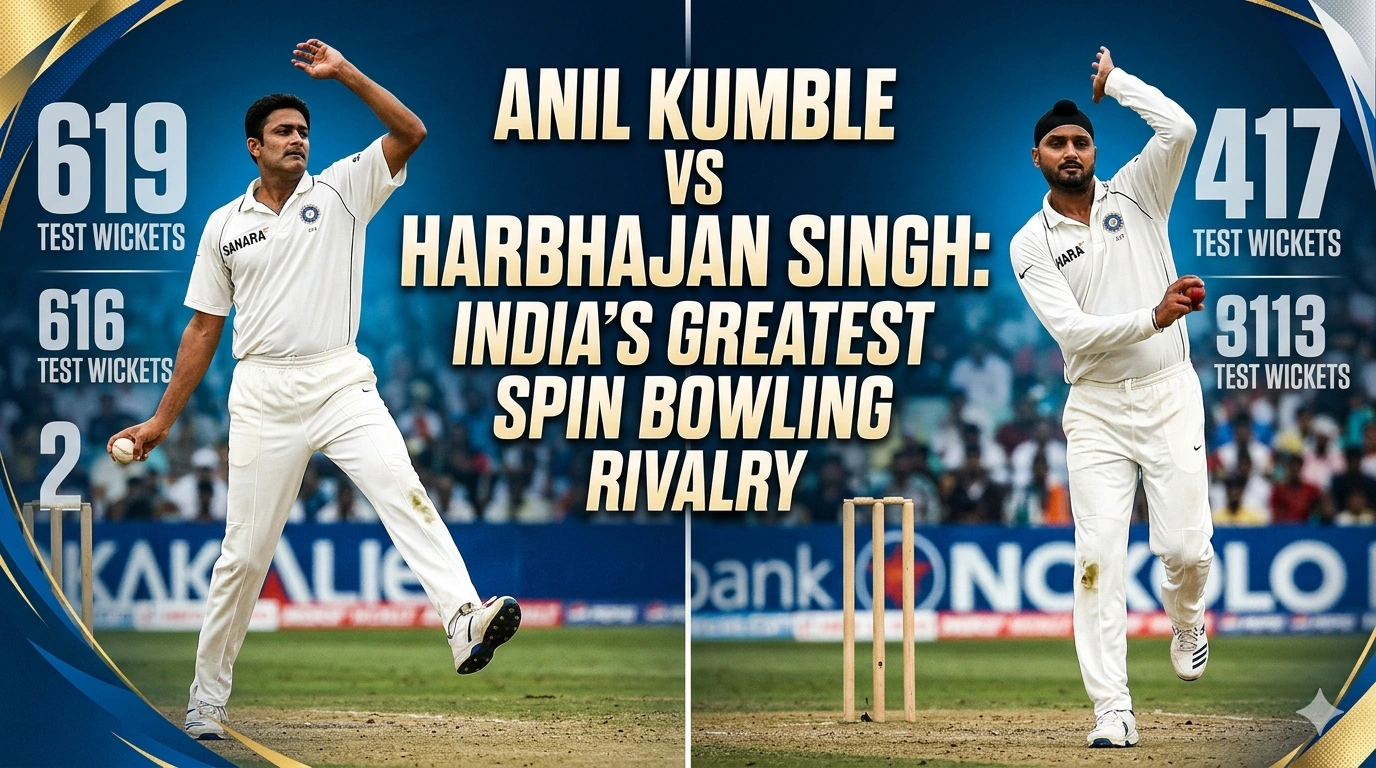
Two spinners. One nation. Entirely different arts. Anil Kumble — the relentless leg-spinner from Bangalore who bowled faster than anyone thought a spinner should, claimed ten wickets in a single innings, and finished with 619 Test wickets — a number only two people in cricket history have ever surpassed. Harbhajan Singh — the combustible off-spinner from Jalandhar who arrived like a thunderclap against Australia in 2001, took the first hat-trick by an Indian in Tests, and became the destroyer of batting lineups on turning Indian pitches for the better part of a decade.
They were not rivals in the traditional sense — they played together for India for several years and formed one of the most feared spin partnerships in world cricket. But they were always in competition for the title of India’s greatest spinner. This article lays every number, every defining moment, and every legacy claim side by side — and makes the case for both.
The Rise of Two Spin Legends
Anil Kumble: Bangalore’s Relentless Spearhead
Anil Kumble made his Test debut against England at Old Trafford in 1990 and took three wickets in his first innings. It was a promising start — but nobody could have predicted what the next 18 years would bring. By the time he retired in 2008, Kumble had taken 619 Test wickets, placing him third on the all-time list behind Muttiah Muralitharan and Shane Warne. He had done something that only one other bowler in the history of the game — Jim Laker in 1956 — had ever achieved: taking all ten wickets in a single Test innings.
What made Kumble exceptional was not the conventional image of a leg-spinner. He did not loop the ball extravagantly or extract dramatic turn. Instead, he bowled quicker than most wrist-spinners, kept an immaculate line and length, used the crease intelligently, and varied pace and flight in ways that drew batters into false positions. His googly improved markedly in his mid-career, adding a new dimension to an already formidable arsenal. He was also remarkably durable — he took wickets in every country he played in, which is something very few spinners of any type can claim.
Harbhajan Singh: Punjab’s Whirlwind
Harbhajan Singh’s Test career nearly ended before it properly began. After a modest debut in 1998, he was dropped and came close to abandoning cricket entirely following the death of his father. What brought him back to the Indian team was one of the most extraordinary bowling performances in the history of Test cricket: 32 wickets in three Tests against Australia in 2001, at a time when no other Indian bowler managed more than three in the series. He was 20 years old.
His action — a high-arm, whirling, windmilling delivery stride — was unique and difficult to read. He turned the ball sharply on helpful surfaces, hurried batters through the air on flat ones, and had the ability to produce a delivery that climbed wickedly from a length to take the edge or the glove. His best weapon was his competitiveness: Harbhajan played as though every wicket was a personal battle, and that emotional intensity made him more dangerous, not less.
10 for 74 — The Perfect Innings
On 7 February 1999 at Feroz Shah Kotla, Delhi, Kumble dismissed every single Pakistani batter in the second innings to finish with 10/74 — only the second instance in Test history of a bowler taking all ten wickets in an innings. Jim Laker had done it for England against Australia in 1956. Pakistan were bowled out for 207. India won by 212 runs. Kumble bowled through the entire innings despite a shoulder injury and never once asked to be taken off.
First Test Hat-Trick by an Indian
During the Eden Gardens Test in March 2001, Harbhajan became the first Indian bowler in history to take a Test hat-trick, dismissing Ricky Ponting, Adam Gilchrist, and Shane Warne in successive deliveries. He finished with 7/123 in that innings. In the same series, his 32 wickets across three Tests — against the most powerful batting lineup in the world at the time — remain one of the most dominant individual series performances in Test history.
6/12 — India’s Greatest ODI Bowling Spell
In the final of the 1993 Hero Cup against the West Indies at Eden Gardens, Kumble bowled what remains the finest ODI spell by an Indian bowler — 6 wickets for just 12 runs from 10 overs. India needed to defend a modest target and Kumble dismantled the West Indian batting lineup in an extraordinary spell that ranks among the most dramatic ODI performances India has ever produced.
One of Cricket’s Greatest Spin Partnerships
In the 34 Tests they played together, India lost a series only once. Their combined 366 wickets in those matches is a figure that reflects how completely they could dismantle opposition lineups when conditions offered them assistance — and sometimes even when conditions did not. Kumble provided the reliability and the over-after-over accuracy; Harbhajan provided the unpredictability and the capacity for sudden destruction.
The Master and the Apprentice — Then Equals
When Harbhajan burst onto the scene in 2001, Kumble was the senior partner without question. But Harbhajan’s form in that Australia series was so astonishing — 32 wickets when Kumble managed 12 — that the balance shifted. For several years in the mid-2000s, both men were India’s joint first-choice spinners, with neither clearly dominant. That competition made both of them better bowlers.
Ponting’s Nightmare Statistic
Harbhajan dismissed Ricky Ponting five times in the 2001 Test series for fewer than 12 runs each time — a statistic that captures how completely he dominated one of the greatest batters of the era on that occasion. Ponting, for all his brilliance, could never quite work Harbhajan out on Indian pitches during that remarkable series.
1993 Hero Cup Final — 6/12
India needed to defend a modest total against the West Indies in the Hero Cup final at Eden Gardens. Kumble bowled one of the most devastating spells in ODI history, taking 6 wickets for 12 runs from 10 overs to win India the match and the tournament. It remains an India record for best ODI bowling figures to this day.
2001 Australia Series — 32 Wickets in 3 Tests
The series that changed everything. On the back of India’s miraculous Kolkata comeback, Harbhajan bowled India to victory in Madras with another five-wicket haul. His 32 wickets at 17.03 in the series made him the leading wicket-taker by a vast margin, and the hat-trick at Eden Gardens — the first by an Indian in Tests — ensured his place in cricket history before he turned 21.
1999 Delhi — 10 for 74 vs Pakistan
The perfect innings. Kumble dismissed every Pakistani batter in the second innings to record match figures of 14/149 and win the Test for India — their first home Test victory against Pakistan in 20 years. He bowled with a shoulder injury throughout and did not ask to leave the field. It remains one of the most remarkable bowling performances in the entire history of Test cricket.
2011 World Cup — Champion on Home Soil
Harbhajan was part of the Indian squad that won the 2011 Cricket World Cup on home soil. He also featured in the 2007 T20 World Cup winning team — the only Indian spinner of his generation to win both global trophies. He took 9 wickets in the 2011 World Cup, including important scalps in the knockout stages.
Antigua 2002 — Bowling with a Fractured Jaw
In the third Test against the West Indies in Antigua, Kumble fractured his jaw while batting. He left the field — and then returned with his jaw strapped in bandages to bowl at Brian Lara in the match’s final session. He bowled 14 overs and took the wicket of Lara himself. It was a performance of extraordinary courage that encapsulated everything about who Kumble was as a cricketer.
The Verdict
In every measurable statistical category, Kumble is the greater bowler. His 619 Test wickets, 35 five-wicket hauls, lower bowling average and economy rate all place him clearly ahead. He is one of only three bowlers in history to take all ten wickets in an innings — a feat that places him in the rarest possible company.
But Harbhajan’s 2001 Australia series stands as perhaps the single greatest spin bowling series performance in Indian history, and his two World Cup medals give him an edge in silverware. He was the more exciting, more volatile, more unpredictable of the two — and on his best days, virtually unplayable.
Jumbo wins in…
Total wickets, average, economy, five-wicket hauls, longevity, 10-wicket innings, all-time ranking. India’s greatest ever bowler.
Bhajji wins in…
World Cup medals, 2001 series performance, hat-trick, emotional impact, and the single greatest spin series by an Indian in the modern era.
Bowling Style and Technical Approach
Kumble: The Spear, Not the Loop
Anil Kumble defied the conventional image of a leg-spinner from the very beginning of his career. Where leg-spinners are traditionally associated with flight, drift, and extravagant turn, Kumble preferred pace, accuracy, and intelligent variation. He bowled quicker than almost any other wrist-spinner in history, keeping a full length that forced batters onto the back foot when they expected to drive, and then deceiving them when they adjusted. His stock ball skidded through and hit the stumps far more often than it turned past the bat.
This approach made him devastating on all surfaces, not just turning pitches. While most spinners are passengers on flat tracks, Kumble continued to take wickets because his accuracy was such that batters could never completely switch off against him. He took wickets in Australia, South Africa, England and the West Indies — places where Indian spinners have historically struggled. His 35 five-wicket hauls in Tests is an India record, and his 619 wickets put him third on the all-time list.
Harbhajan: Fire, Turn, and Theatre
Harbhajan Singh’s greatest weapons were his doosra — the off-spinner’s equivalent of a leg-break — his ability to extract steep bounce from a length, and an intensity at the bowling crease that communicated itself to the crowd. He was a spinner who made batting feel like a high-stakes confrontation rather than a technical exercise, and that psychological dimension was a genuine part of his effectiveness.
He turned the ball more than Kumble and was more reliant on helpful surfaces. On flat pitches, his economy was reasonable but his wicket-taking rate dropped. On dusty, turning Indian pitches, he was among the most dangerous bowlers in the world. His best bowling — the 2001 Australia series, his performances against Pakistan at home — was as good as anything produced by an Indian spinner in the modern era. His competition with Kumble for India’s spinner spot made him work harder and become better than he might otherwise have been.
The Kumble–Harbhajan Partnership
From approximately 2001 to 2007, Kumble and Harbhajan formed the backbone of India’s Test bowling attack together, and the results were remarkable. In the 34 Tests they played as a pair, India lost a series only once. Their combined 366 wickets in those matches represents one of the most productive spin partnerships in Test history.
What made them complementary was the contrast in their methods. Kumble bowled from one end with tireless accuracy, keeping batters pinned, taking wickets with the skidding leg-break and the occasional sharp googly. Harbhajan bowled from the other end with more flight, more turn, and considerably more theatre — his tendency to celebrate wickets loudly and gesticulate at batters added to the pressure the opposition felt. The combination of methodical accumulation and sudden explosive threat was very difficult to counteract over a long innings.
Their relationship off the field was, by various accounts, complex. The 2001 series briefly made Harbhajan the more prominent of the two — his 32 wickets to Kumble’s 12 was an unusual reversal of their usual respective contributions. Kumble handled this with characteristic dignity, and the two continued to play together effectively for several more years. Their different temperaments — Kumble’s reserve versus Harbhajan’s expressiveness — were a microcosm of the broader variety of Indian cricket’s personality.
The Moments That Defined Their Careers
Kumble’s career had two moments that transcend statistics. The first was his 6/12 in the 1993 Hero Cup final — a spell so sudden and devastating that the Eden Gardens crowd could barely process what they were watching. The second was his 10/74 in Delhi in 1999 — the perfect innings, achieved against Pakistan on a charged occasion, through discomfort, with the calmness of someone who had decided that pain was simply not relevant to what he needed to do.
Harbhajan’s defining moment came across three weeks in February and March 2001. The hat-trick at Eden Gardens — Ponting, Gilchrist, Warne dismissed in successive balls — was the moment India’s dressing room understood they were dealing with something exceptional. What followed, as India won the series 2–1 against the world’s best team, was the series that changed Indian cricket’s self-perception. Harbhajan was at the centre of all of it.
Both men also showed extraordinary courage in adversity. Kumble’s decision to continue bowling in Antigua with a fractured, bandaged jaw — and then to dismiss Lara — is one of cricket’s great warrior stories. Harbhajan’s resilience in returning to the team after personal tragedy following his father’s death, and then producing the greatest series of his career within months, is its own kind of remarkable.
Legacy: What Indian Cricket Owes These Two Men
Indian spin bowling’s reputation in the modern era was built on the shoulders of Kumble and Harbhajan. When Ravichandran Ashwin arrived to eventually surpass both of them in terms of wickets, he was walking a path that they had carved. The expectation that India’s spin attack would be the decisive factor in home Tests — and increasingly in overseas Tests — was an expectation that Kumble and Harbhajan made credible through two decades of consistent wicket-taking.
Kumble is India’s greatest ever bowler, and arguably one of the five greatest bowlers of any type in the history of Test cricket. His 619 wickets, his consistency across conditions and formats, and his 10-wicket innings make the case irrefutably. He served Indian cricket as player, captain, and head coach — a complete cricketing life of service to the game he loved.
Harbhajan’s contribution, while statistically lesser, should not be underestimated. His 2001 performances gave Indian cricket a moment of belief that transcended the statistics. His 417 Test wickets make him one of the most prolific off-spinners India has ever produced. His two World Cup medals — the 2007 T20 World Cup and the 2011 ODI World Cup — give him something Kumble never had: a global tournament winner’s medal.
Together, they gave Indian cricket a decade and a half of spin-bowling excellence that the nation’s supporters had rarely experienced before, and have since come to expect as standard.
Also Read- Rahul Dravid vs Sourav Ganguly