
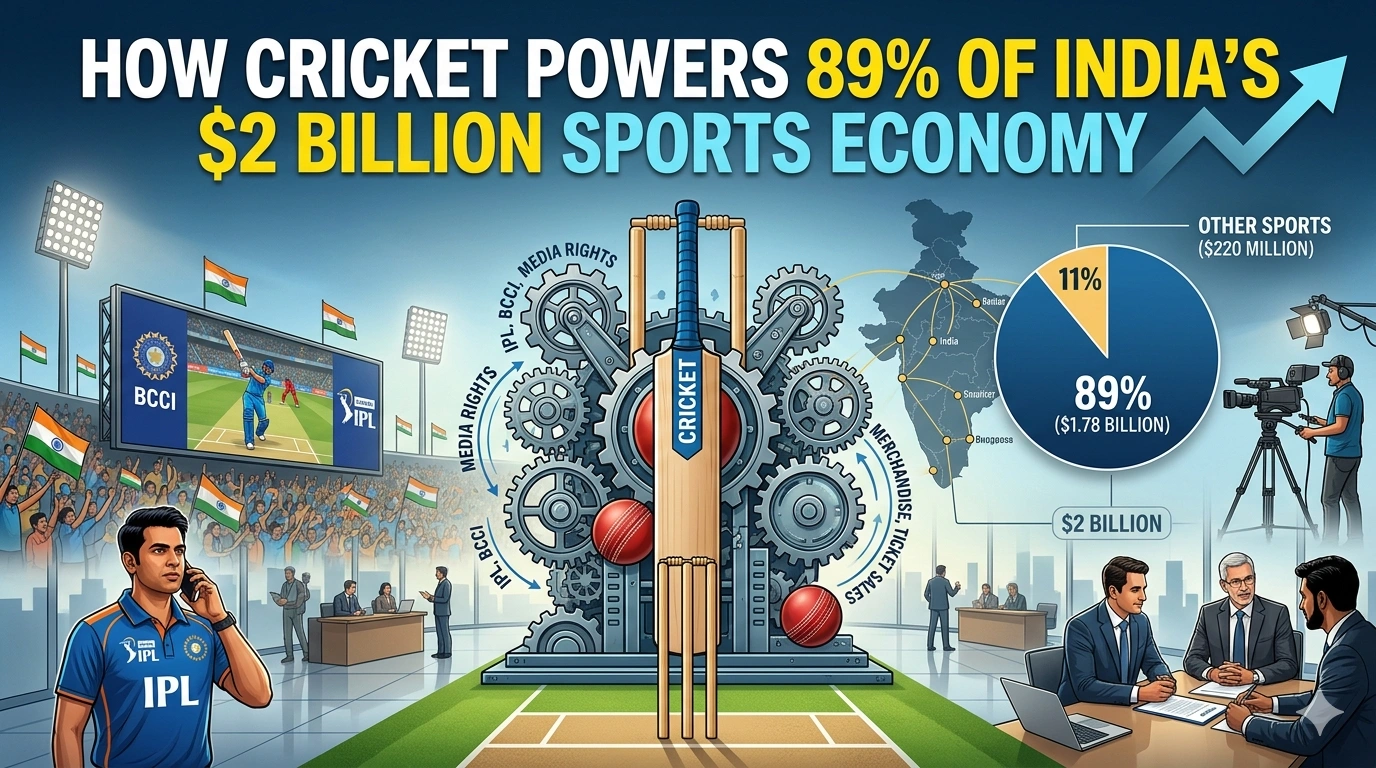
India’s sports economy has officially crossed the $2 billion mark in 2025, marking a historic milestone in the country’s sporting and commercial evolution. The industry reached approximately ₹18,864 crore, reflecting strong year-on-year growth and signaling a more structured and mature business environment. :contentReference[oaicite:0]{index=0}
This surge is not just about rising numbers — it represents a deeper transformation in how sports are consumed, monetized, and integrated into India’s broader entertainment ecosystem.
Key Highlights
- 📈 India’s sports market crossed $2 billion for the first time in 2025.
- 🏏 Cricket alone contributes nearly 89% of the total industry value.
- 📺 Media spending is the biggest driver, accounting for over half of total revenue.
- 💰 Sponsorships and endorsements continue to grow steadily.
- 🚀 The ecosystem has nearly doubled in size since 2021.
Cricket’s Unmatched Dominance
Despite the overall growth of the sports sector, cricket remains the undisputed leader in India. In 2025, it generated nearly ₹16,700 crore, accounting for close to 90% of the total industry revenue. :contentReference[oaicite:1]{index=1}
The dominance extends across all major revenue streams — from sponsorship deals and media rights to brand endorsements. Major tournaments like the Indian Premier League (IPL), along with international successes, have played a crucial role in maintaining cricket’s commercial supremacy.
Even emerging platforms like the Women’s Premier League (WPL) are strengthening cricket’s ecosystem, ensuring year-round engagement and monetization opportunities.
Media: The Biggest Growth Engine
One of the most significant drivers of this economic boom has been media investment. Over 50% of the total sports economy value now comes from media rights and advertising. :contentReference[oaicite:2]{index=2}
Digital platforms, in particular, are witnessing rapid expansion, with brands increasingly shifting budgets toward online streaming and mobile-first audiences. This shift is transforming how fans consume sports — making it more interactive, accessible, and data-driven.
Sponsorship and Endorsements Rising
Brand partnerships continue to play a vital role in the sports economy. Sponsorship spending has grown steadily, driven by premium deals and better monetization of existing properties rather than just expanding inventory.
At the same time, athlete endorsements have crossed ₹1,300 crore, with cricketers dominating this segment as well. :contentReference[oaicite:3]{index=3}
Interestingly, brands are now moving beyond traditional advertising. Athletes are becoming long-term partners, involved in storytelling, campaigns, and even equity-based collaborations.
A Rapidly Growing Industry
India’s sports economy has nearly doubled in just four years, growing from around ₹9,500 crore in 2021 to its current level. :contentReference[oaicite:4]{index=4}
This consistent growth reflects a shift from a fragmented market to a more organized and scalable industry. Increased fan engagement, better infrastructure, and stronger governance are all contributing to this upward trajectory.
The Big Question: Beyond Cricket?
While the growth numbers are impressive, they also highlight a major challenge — the heavy reliance on cricket. Other sports like football, badminton, and hockey still occupy only a small share of the market.
Experts believe that the next phase of growth will depend on building a multi-sport ecosystem, supported by grassroots development, infrastructure investment, and broader media coverage.
Future Outlook
- 📊 Expansion of digital media will drive further growth.
- 🏟️ Investment in infrastructure will boost other sports.
- 🌍 Global leagues and partnerships will increase revenue streams.
- 🎯 Focus on grassroots development will shape long-term success.
Final Word
India’s sports economy crossing the $2 billion mark is more than just a financial milestone — it represents the country’s growing influence in the global sports business landscape.
However, the journey ahead will depend on whether India can reduce its dependence on cricket and create a more balanced, multi-sport ecosystem. For now, the numbers tell a clear story — India is growing rapidly, but it remains, above all, a cricket-driven economy.
Also Read- Aditya Dhar U-19