
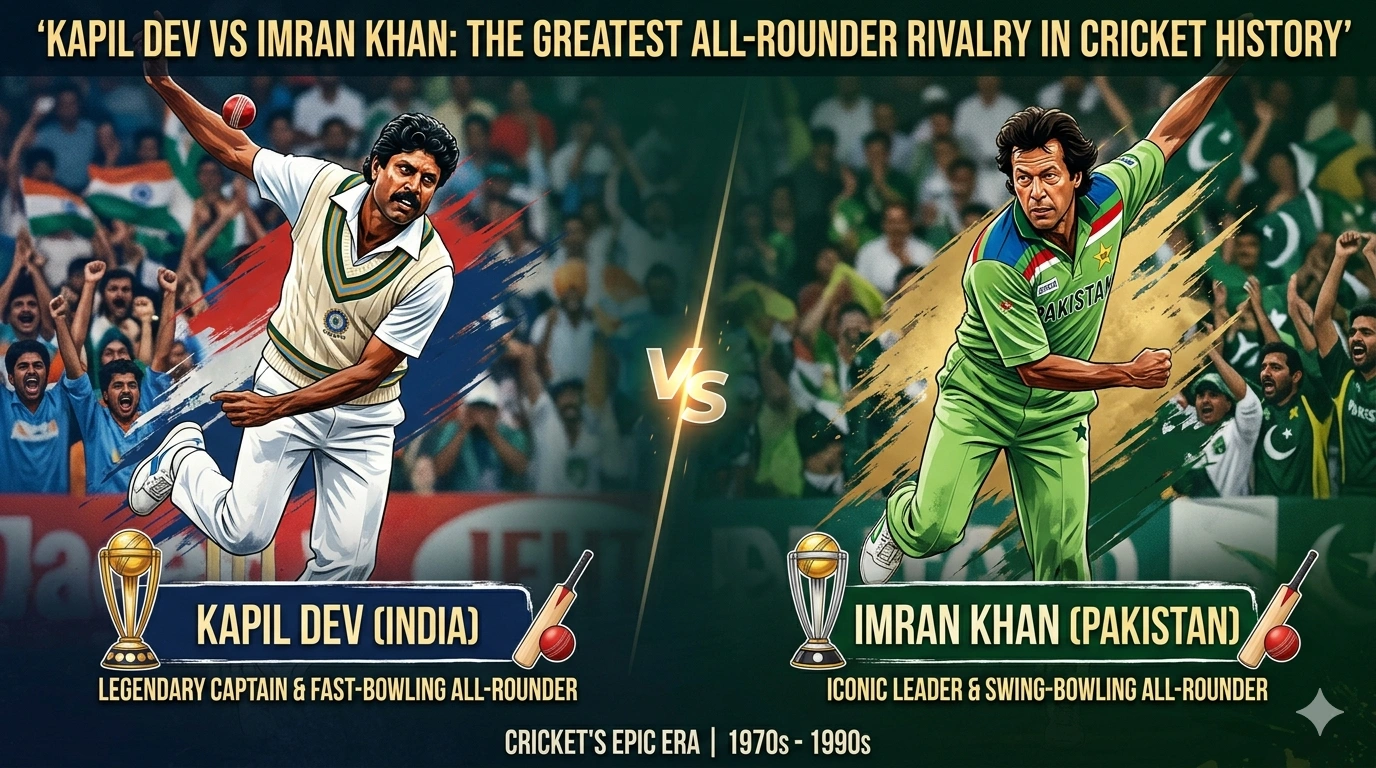
The 1980s produced four all-rounders who towered over every other cricketer on the planet — Ian Botham, Richard Hadlee, Kapil Dev, and Imran Khan. Of that celebrated quartet, the two from the subcontinent inspired the most passionate and enduring debate. Kapil Dev — the Haryana Hurricane, India’s first genuine fast-bowling all-rounder, who took 434 Test wickets and scored 5,248 Test runs, and lifted the World Cup in 1983 against all imaginable odds. Imran Khan — the Lion of Lahore, Pakistan’s most complete cricketer, whose Test bowling average of 22.81 was better than the other three, who led Pakistan to the 1992 World Cup, and whose batting average of 37.69 made him genuinely capable of winning matches with the bat alone.
Both were fast bowlers who could bat. Both were match-winning captains. Both lifted the World Cup. But they were very different cricketers, with very different strengths — and the debate between them has never been settled to anyone’s complete satisfaction. This article lays every number, every defining moment, and every legacy claim side by side and examines them honestly.
The Rise of Two All-Rounder Legends
Kapil Dev: India’s First Fast-Bowling All-Rounder
Before Kapil Dev arrived, India had never produced a genuine fast-bowling all-rounder. The country’s cricketing identity was built around spin — Bedi, Chandrasekhar, Prasanna, Venkataraghavan — and technically correct batting. Kapil changed everything. When he made his Test debut against Pakistan in Faisalabad in 1978 at the age of 19, he bowled with a pace and aggression that Indian cricket had simply never seen from one of its own, and he batted with a freedom and ferocity that made watching him an event in itself.
What Kapil brought was not just talent but an entirely new template for what an Indian cricketer could be. He swung the ball both ways at genuine pace, he took wickets on flat pitches when others could not, and he hit sixes with a casual violence that suggested he was playing a slightly different game from the one around him. By 1983, he had become the most important cricketer India had ever produced — and then he went and led India to the World Cup, which nobody outside his own dressing room had considered remotely possible.
Imran Khan: Pakistan’s Lion and Leader
Imran Khan’s trajectory to greatness was slower than Kapil’s but the destination was higher. He made his Test debut in 1971 at the age of 18, and for the first six years of his career he was a promising but inconsistent swing bowler. The transformation into one of the game’s all-time greats came after he refined his action at Sussex and Oxford, mastering the art of reverse swing — a skill he later passed on to Wasim Akram and Waqar Younis, ensuring his influence on Pakistani fast bowling lasted three decades beyond his own retirement.
At his peak — which ESPNCricinfo identifies as the decade from 1980 to 1988, during which he took 236 wickets at an average of 17.77 — Imran was arguably the best fast bowler in the world, period. Not just the best all-rounder — the best outright bowler. His batting average of 37.69 in Tests, and 51 in his final decade of international cricket, placed him among the best batting all-rounders the game had ever seen. His averages with both bat and ball were superior to those of Botham, Hadlee, and Kapil, which is the cornerstone of his claim to be the greatest of the four.
Kapil’s Unique Double: 400 Wickets + 5,000 Runs in Tests
Kapil Dev remains the only player in the history of Test cricket to have taken more than 400 wickets and scored more than 5,000 runs. This unique double captures what made him exceptional as an all-rounder — not just that he contributed in both departments, but that he contributed at volume in both departments across 16 years of Test cricket.
Imran’s Peak Decade: 236 Wickets at 17.77 (1980–1988)
From January 1980 to 1988, Imran took 236 Test wickets at a bowling average of 17.77 — numbers that compare favourably with those of Richard Hadlee, Malcolm Marshall, Dennis Lillee, Joel Garner and Michael Holding during the same period. In his final decade of international cricket, he also averaged 51 with the bat, a figure that any specialist batter would be proud of.
175* vs Zimbabwe — The Greatest Rescue Act in ODI History
In the 1983 World Cup at Tunbridge Wells, India were reduced to 17/5 chasing a modest total against Zimbabwe. Kapil Dev walked in and hit an unbeaten 175 off 138 balls — the highest score in ODI history at the time — including 16 fours and 6 sixes. There was no TV broadcast of the innings due to a satellite feed failure. India won by 31 runs. The knock saved India’s World Cup campaign and remains, for many, the single greatest ODI innings ever played.
Imran’s 6/14 — The Most Destructive ODI Spell by a Fast Bowler
Against India in Sharjah in 1984, Imran Khan took 6 wickets for just 14 runs — one of the most devastating ODI bowling performances ever recorded, and still the best figures in the history of Pakistan-India ODI encounters. It captured his ability to dismantle a batting lineup with sudden, terrifying efficiency when conditions suited him.
Imran: Pakistan’s Greatest Captain
Imran led Pakistan in 48 Tests with 14 wins — the most Test victories by any Pakistani captain in history. His win rate of 29% is the best of any long-serving Pakistan captain. He led Pakistan to their first Test series wins in England (1987) and India (1987), and captained the 1992 World Cup winning side in what was his final competitive match — a fairytale ending to the most complete captaincy career Pakistan has ever produced.
Kapil: The 1983 World Cup — Cricket’s Greatest Underdog Story
When India walked out to face the West Indies in the 1983 World Cup final at Lord’s, they were 66-1 outsiders. The West Indies had won the previous two World Cups and were considered unbeatable. Kapil’s India won by 43 runs. His leadership throughout the tournament — and his famous running catch to dismiss Vivian Richards in the final when India needed a moment of brilliance — made him the most celebrated captain in Indian cricket history. The manner of the win, against those opponents, in those circumstances, elevates his captaincy legacy beyond the statistics.
1983 World Cup — India’s Impossible Dream
Kapil Dev led India from 17/5 against Zimbabwe with an unbeaten 175 to save the World Cup campaign, then guided them past England in the semi-final, and finally captained them to victory over the West Indies in the final. He took the catch to dismiss Viv Richards — running back from mid-on with complete certainty — that changed the course of the match. The image of Kapil lifting the Prudential Cup at Lord’s is one of Indian sport’s most enduring photographs.
1992 World Cup — Cornered Tigers to Champions
With Pakistan on the verge of elimination in the 1992 World Cup, Imran delivered his “cornered tigers” speech, imploring his team to fight with the ferocity of animals with no escape. Pakistan won every remaining match and eventually beat England in the final in Melbourne. Imran scored 72 off 110 balls and took 1 wicket in the final, then lifted the trophy at the age of 39, seven years after he had first announced his retirement from international cricket.
1982–83 Series vs India — Imran at His Most Devastating
In the six-Test series against India, Imran took 40 wickets at an average of 13.95 — one of the most destructive individual bowling series performances in Test history. He bowled with such pace and hostility that even Sunil Gavaskar, who faced the West Indies pace attack without flinching, later admitted he found Imran more difficult to face in those conditions. The series cost Imran a stress fracture in his shin and kept him out of cricket for two years — the injury that perhaps prevented him from taking even more wickets.
1983 — 9/83 vs West Indies: India’s Greatest Test Bowling
In the Ahmedabad Test against the West Indies in 1983 — the same year as the World Cup — Kapil took 9 wickets for 83 runs in an innings, including Gordon Greenidge, Desmond Haynes, Viv Richards, Clive Lloyd and Jeff Dujon. His match figures of 10/135 remain the best by any Indian Test captain. It was a performance that demonstrated he could take wickets against the very best batting lineup in the world, at home, on a flat pitch, when India needed him most.
Antigua 1988 — Leading Pakistan to West Indies Victory
At a time when no team beat the West Indies in the West Indies, Imran led Pakistan to a series victory in 1988 — one of the most remarkable achievements in Test cricket during that era. He was named Man of the Series, taking 23 wickets in three Tests. This win cemented his place as one of the greatest captains the game had ever seen and underlined that Pakistan, under Imran, could genuinely compete with and beat the dominant force in world cricket.
Lord’s 1990 — Four Consecutive Sixes off Eddie Hemmings
In one of the most audacious moments in Test history, Kapil Dev — needing to avoid following on — hit Eddie Hemmings for four consecutive sixes at Lord’s to save India from the follow-on. He became the first player in Test history to hit four sixes in a row. The innings of 55 not out saved the match and demonstrated that even in crisis, Kapil’s solution was always to attack.
Cricketer of Century
of Pakistan
The Verdict
This is genuinely the closest debate in all of cricket. Kapil wins on volume — more wickets, more runs, more matches, and the unique double of 400+ wickets and 5,000+ runs that no one else in history has achieved. He was also the more durable and consistent performer across a longer career.
Imran wins on averages — his bowling average of 22.81 is far superior to Kapil’s 29.65, and his batting average of 37.69 surpasses Kapil’s 31.05. His bowling strike rate was better. His captaincy record was better. His peak decade was arguably the most dominant sustained spell by any fast-bowling all-rounder in history.
Both captained their nation to a World Cup. Both changed what cricket in South Asia could look like. The debate is not one you settle — it is one you enjoy.
🇮🇳 Kapil wins in…
Volume of wickets and runs, unique 400/5000 double, longevity, the 175* ODI innings, 1983 World Cup, and Wisden Indian Cricketer of the Century.
🇵🇰 Imran wins in…
Bowling and batting averages, strike rate, captaincy win rate, peak decade, 1992 World Cup, Test series wins in England and India, six ten-wicket matches.
Bowling: Different Styles, Equal Menace
Kapil Dev: The Swing Bowler Who Never Stopped
Kapil Dev’s bowling was built around two things: the ability to swing the ball at genuine pace, and an extraordinary, almost supernatural stamina that allowed him to bowl long spells in conditions that should have stopped a fast bowler in his tracks. On Indian pitches — typically flat, dry, and of no assistance to pace — Kapil was still capable of creating problems through sheer accuracy and relentless effort. He swung the ball both ways, could cut the ball off the pitch when conditions allowed, and disguised his variations better than most fast bowlers of his era.
His 434 Test wickets across 131 matches — at a time when India played far fewer Tests than the leading nations and on pitches that heavily favoured batters — represents a bowling achievement of staggering proportions. He remains the only bowler in history to take 400+ wickets and score 5,000+ Test runs, and that combination speaks to an all-round contribution that no other cricketer has replicated across such a long career.
Imran Khan: The Master of Reverse Swing
Imran Khan’s bowling evolved from raw, aggressive pace in his early career to something considerably more sophisticated by the late 1970s and early 1980s. He was among the first bowlers to master reverse swing — the technique of making an old ball move in the opposite direction to conventional swing — a skill he learned from Sarfraz Nawaz and later taught to Wasim Akram and Waqar Younis. That knowledge transfer alone changed the history of fast bowling.
His Test bowling average of 22.81 is the foundation of his claim to be the greatest of the four great all-rounders. Over his best decade — 1980 to 1988 — it dropped to 17.77, a figure that places him alongside the outright fastest bowlers of that era, not merely the all-rounders. He had six ten-wicket match hauls in Tests to Kapil’s two, and his bowling strike rate of 53.8 was markedly better than Kapil’s 63.9 — meaning Imran, on average, took a wicket every nine fewer deliveries.
Batting: The All-Rounder’s Second Art
As batters, both men were uninhibited and effective, but in different ways. Kapil was an attacker first, last, and always. He hit the ball enormously hard, loved the drive and the pull, and had almost no interest in batting for time when batting for runs was an option. His Test batting average of 31.05 is respectable for a number seven or eight, but it does not capture the entertainment value or the match-turning potential of his best innings. The 175* against Zimbabwe and the four consecutive sixes off Eddie Hemmings at Lord’s in 1990 are just two examples of an innings-maker who could change a match in a session.
Imran was the more complete batsman. His Test average of 37.69 would have secured him a place in most Test sides as a batting specialist alone. In his final decade of international cricket, this average rose to 51 — a figure that suggests that, far from declining as a batter as he aged, Imran actually improved. His technique was sound, his temperament in difficult situations outstanding, and his ability to play a long innings when his team needed one — as in the 1992 World Cup final — made him a batter of genuine substance.
Captaincy: World Cup Winners Both
Both men won the Cricket World Cup as captain. Both transformed their respective nations’ approach to the game. The comparison of their captaincy records, however, favours Imran clearly in statistical terms. He led Pakistan in 48 Tests with 14 wins and a win rate of approximately 29%. Kapil led India in 34 Tests with just 4 wins. The difference in win rates is significant — though it should be noted that Kapil was often working with a weaker team and in more difficult circumstances than Imran, who had Wasim Akram, Waqar Younis, Javed Miandad, and Zaheer Abbas in his side.
What cannot be captured by win rates, however, is the sheer improbability and impact of Kapil’s 1983 World Cup victory. India were 66-1 outsiders before the tournament began. The West Indies had won the previous two editions and were unambiguously the greatest team in the world. Kapil’s India defeated them in the final at Lord’s, and in doing so changed Indian cricket’s self-belief in a way that Imran’s 1992 win — which was itself a remarkable achievement — arguably did not match in terms of historical impact. Both wins were extraordinary. Kapil’s was the greater shock.
Defining Moments That Shaped Cricket History
The 175* at Tunbridge Wells needs no further elaboration here. It is, by any definition, one of the five greatest ODI innings ever played, and it came at a moment when India’s entire World Cup campaign had effectively ended. The fact that there is no broadcast footage of it — the satellite link failed — means it exists almost entirely in the memory of those who were there and in the accounts of those who followed it over radio commentary, which has given it a mythical quality that perfectly matches what it actually was.
Imran’s defining moment is harder to reduce to a single innings or spell. His 1982–83 series against India — 40 wickets at 13.95 — is the most obvious statistical peak. But the 1992 World Cup story is perhaps the more resonant: a 39-year-old, seven years after his first retirement, standing on the balcony at the MCG with the trophy, having carried Pakistan almost personally through the knockout stages on will, experience, and the belief that his team was capable of winning if they bowled and batted as he knew they could. It was the perfect final chapter.
Legacy: What the Game Owes Them
Kapil Dev was voted the Wisden Indian Cricketer of the Century in 2002 — ahead of Sunil Gavaskar and Sachin Tendulkar. That vote, by cricket writers and historians, captures the scale of his influence on Indian cricket: he was not just a great player, he was a transformative figure who showed an entire nation a different way of playing the game. The fast-bowling tradition in Indian cricket — Javagal Srinath, Zaheer Khan, Ishant Sharma, Mohammed Shami, Jasprit Bumrah — traces its lineage directly back to him.
Imran Khan’s legacy extends well beyond cricket. After retirement he founded the Shaukat Khanum Cancer Hospital in Pakistan — one of the most significant philanthropic acts by any sportsperson in South Asian history — established a university in Mianwali, entered politics, and eventually became Prime Minister of Pakistan in 2018. His post-cricket life, whatever one’s political views, represents a genuinely unique transition from sporting greatness to national leadership. No other cricketer of his era came close to matching the breadth of his life after the game.
As cricketers, both men belong to the very highest level the game has produced. The question of which was greater is the kind of question that has no final answer — which is precisely why it has been argued, with great heat and equal pleasure, by cricket fans across India and Pakistan for more than forty years. That the debate continues is the greatest tribute either man could receive.
Also Read- Anil Kumble vs Harbhajan Singh