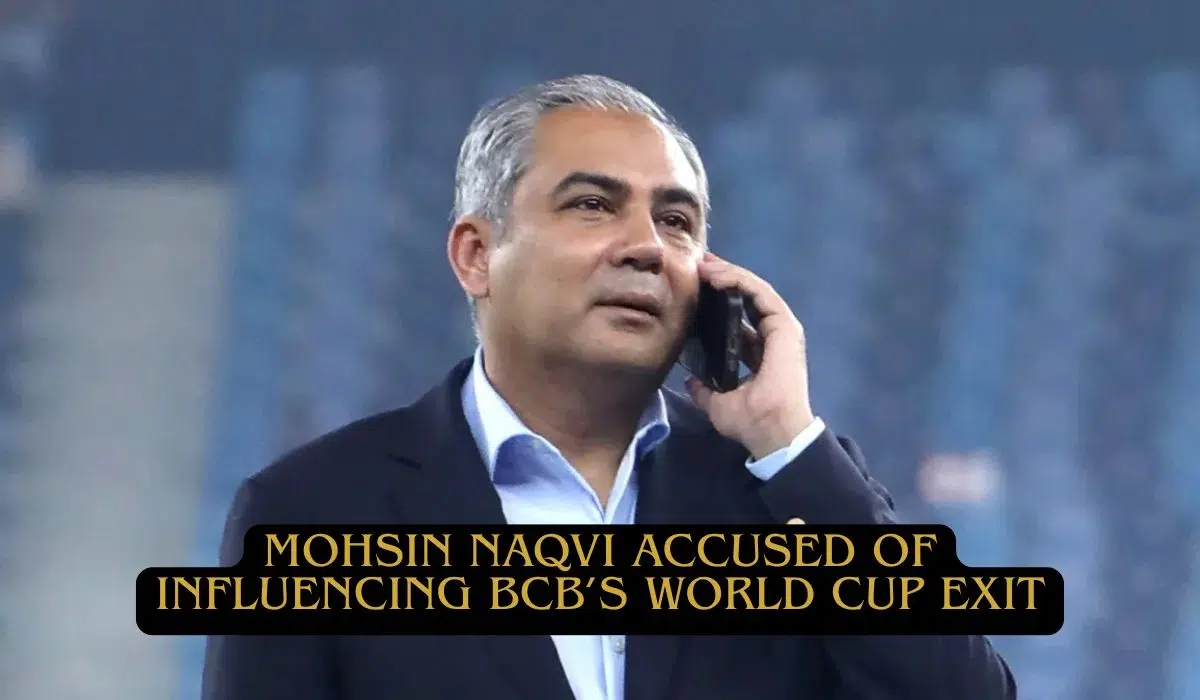
A former senior official of the Bangladesh Cricket Board (BCB) has made a striking allegation involving Pakistan Cricket Board (PCB) chairman Mohsin Naqvi and the controversial withdrawal of Bangladesh from the ICC Men’s T20 World Cup 2026.
Syed Ashraful Haque, who once served as general secretary of the BCB and chief executive of the Asian Cricket Council (ACC), believes that Naqvi unduly influenced the BCB leadership in its decision-making process leading up to the World Cup.
Haque’s comments came during a recent interview with RevSportz, in which he offered a harsh assessment of the chain of events that culminated in Bangladesh’s withdrawal from the global T20 event.
What Happened With Bangladesh and the T20 World Cup?
Bangladesh had qualified for the ICC Men’s T20 World Cup 2026, co-hosted by India and Sri Lanka.
However, they refused to travel to India for matches, citing security concerns after the Kolkata Knight Riders released Mustafizur Rahman from their IPL squad at the request of the Board of Control for Cricket in India (BCCI).
The International Cricket Council (ICC) refused to relocate Bangladesh’s scheduled games, leaving the board with a choice: play in India or forfeit points.
When Bangladesh stood firm on their refusal to travel, they were removed from the tournament altogether, replaced by Scotland in the group stage.
The Allegation: Was Mohsin Naqvi Involved?
According to Haque, Aminul Islam, the current BCB president, lacked the experience and diplomatic understanding required in global cricket affairs and was “naive” in the decisions surrounding the withdrawal.
Haque claims that Naqvi, who also serves as the ACC president, played a role in persuading Bangladesh’s leadership to adopt these controversial positions.
“As a cricket administrator, I focus on honesty and commitment. Aminul Islam, likely being naive, was influenced by Mr. Mohsin Naqvi… At the end of the day, who won?” Haque remarked in the interview.
Haque’s comments suggest that the cricket politics between national boards may have overshadowed sporting interests, ultimately harming Bangladesh’s players and their fans.
He stressed that strong ties with Indian cricket authorities could have benefitted Bangladesh, both on the field and in administrative influence, but those opportunities were lost due to strategic errors.
A Loss Beyond the Cricket Field
The fallout from Bangladesh’s withdrawal has had ramifications beyond just missing matches.
The team’s absence from the World Cup has disappointed passionate cricket supporters in Bangladesh, a nation where cricket is almost a religion after India.
Haque emphasized that players such as Liton Das, Mustafizur Rahman, and Najmul Shanto missed out on showcasing their skills on one of the sport’s biggest stages due to administrative missteps.
Haque also criticized how the Bangladesh government and BCB handled the situation, saying there was ample time for talks with the BCCI or even the Indian government to address any security concerns.
He described the decision to withdraw as “premature” and something that could have been avoided with stronger leadership.
Politics and Cricket: A Continuing Challenge
The controversy highlights how closely sports and diplomacy are intertwined in South Asia.
Bangladesh’s removal from the T20 World Cup followed Pakistan’s initial threat to boycott its match against India, a situation that was only resolved after complex discussions with the ICC and other stakeholders.
Mohsin Naqvi’s role in regional cricket has also drawn attention elsewhere, with critics in Pakistan arguing over his leadership decisions and the mixing of cricket administration with government duties.
These ongoing tensions reflect deeper structural and political complexities that influence cricket governance across the subcontinent.
What’s Next for Bangladesh Cricket?
Following these events, Bangladesh has experienced a change in political leadership.
The new government and sports minister have indicated a desire to improve relations with cricket authorities in India and the BCCI, signaling that efforts might be underway to rebuild bridges and prevent similar outcomes in the future.