
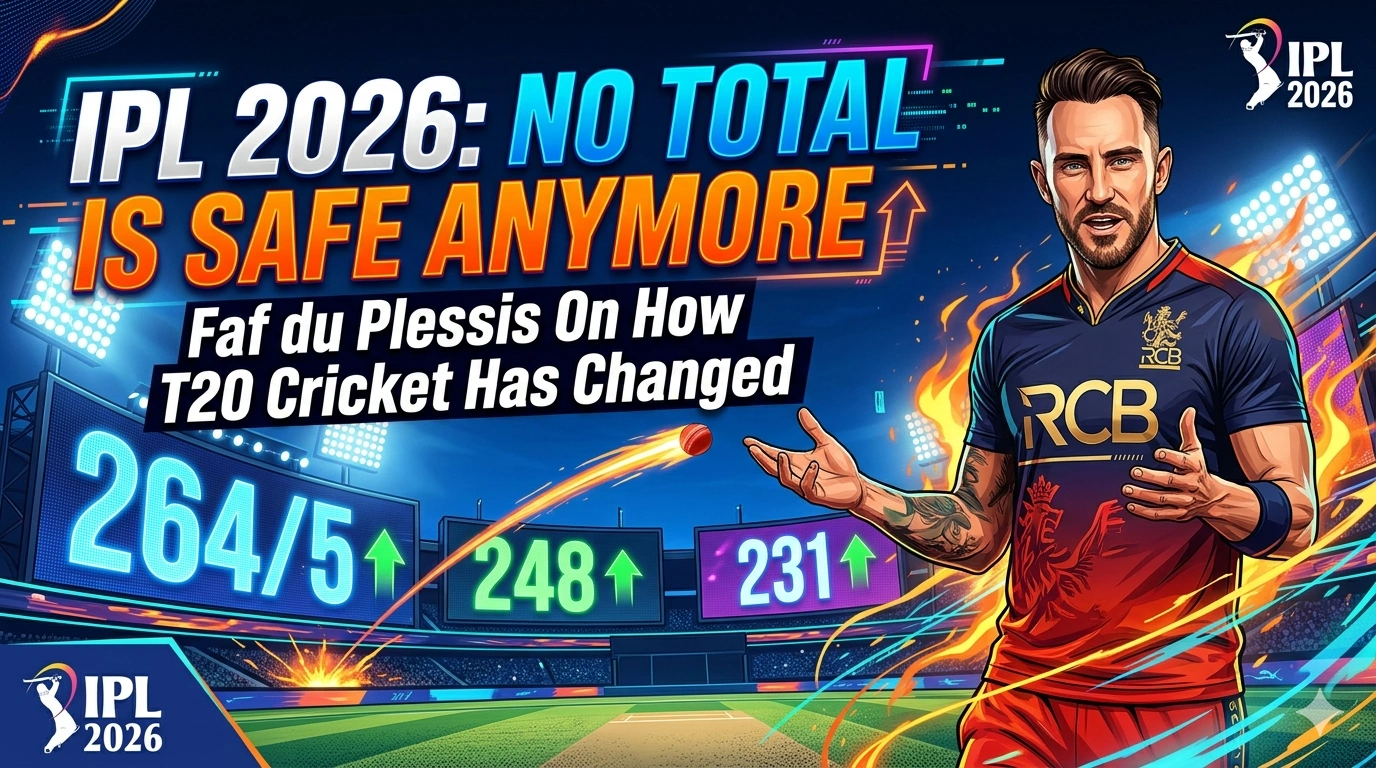
T20 cricket has entered a new phase, and according to Faf du Plessis, the rules of the game are being rewritten.
Speaking during Indian Premier League 2026, he made a bold statement: “No total is safe anymore.”
This reflects a clear shift in modern cricket, where even massive totals are no longer enough to guarantee victory.
T20 Cricket Has Become a Batting-Dominated Format
Over the past few years, T20 cricket has seen a sharp rise in scoring rates. What used to be considered a winning total is now often chased down with ease.
Du Plessis pointed out that scores around 160–170 were once competitive, but today they are below par. Even totals above 200 are being chased regularly, especially in leagues like the IPL.
Modern T20 batting is defined by:
- Aggressive intent from the very first over
- Maximum use of powerplay restrictions
- Explosive finishing in the death overs
This shift has made matches more unpredictable and exciting.
What Does “No Total Is Safe” Really Mean?
The statement is not just about high scores—it highlights how quickly the game can change.
According to Du Plessis:
- Matches often go down to the final over
- Bowlers are under constant pressure
- One over can completely change the outcome
In today’s T20 format, even a strong position can collapse within minutes.
IPL 2026: A Season of Big Scores
Indian Premier League 2026 has already showcased the evolving nature of T20 cricket. High-scoring matches have become a regular feature this season.
Key trends include:
- Frequent 180+ team totals
- Multiple successful chases of 200+ scores
- Higher strike rates across teams
These patterns confirm that batting standards have reached another level in 2026.
Why Bowlers Are Finding It Tough
While batting has evolved rapidly, bowlers are facing increasing challenges. Du Plessis acknowledged that this format is becoming extremely demanding for them.
Some of the main reasons include:
- Smaller grounds and shorter boundaries
- Flat pitches designed for batting
- Advanced hitting techniques
- Fearless approach from batters
To survive, bowlers now need to rely heavily on variations, accuracy, and smart field placements.
Evolution of Batting Techniques
Modern batters are not just relying on timing—they are combining power with innovation.
Common features of today’s batting:
- 360-degree shot-making ability
- Use of scoops, reverse hits, and ramps
- Consistent boundary-hitting under pressure
This evolution has made it harder for bowlers to predict and control scoring.
What Lies Ahead for T20 Cricket?
Du Plessis’ comments suggest that the future of T20 cricket will continue in this direction.
Possible developments include:
- Even higher average scores
- More emphasis on aggressive strategies
- Increased importance of adaptable bowling
Teams will need to constantly adjust to keep up with the fast-changing nature of the format.
Impact on Global Cricket
The IPL continues to influence T20 cricket worldwide. The trends seen in the tournament often shape how the game is played in other leagues.
As a result:
- Young players are adopting aggressive styles early
- Teams are prioritizing power-hitters
- Fans are enjoying more high-scoring thrillers
Du Plessis’ observation highlights how the IPL remains at the center of cricket’s evolution.
Conclusion
Faf du Plessis’s statement, “No total is safe anymore,” perfectly sums up the current state of T20 cricket.
With the kind of high-scoring matches seen in Indian Premier League 2026, it is clear that the balance has shifted heavily in favor of batters.
As the format continues to evolve, one thing is certain—fans can expect more thrilling finishes, bigger scores, and a game that keeps pushing its own limits.