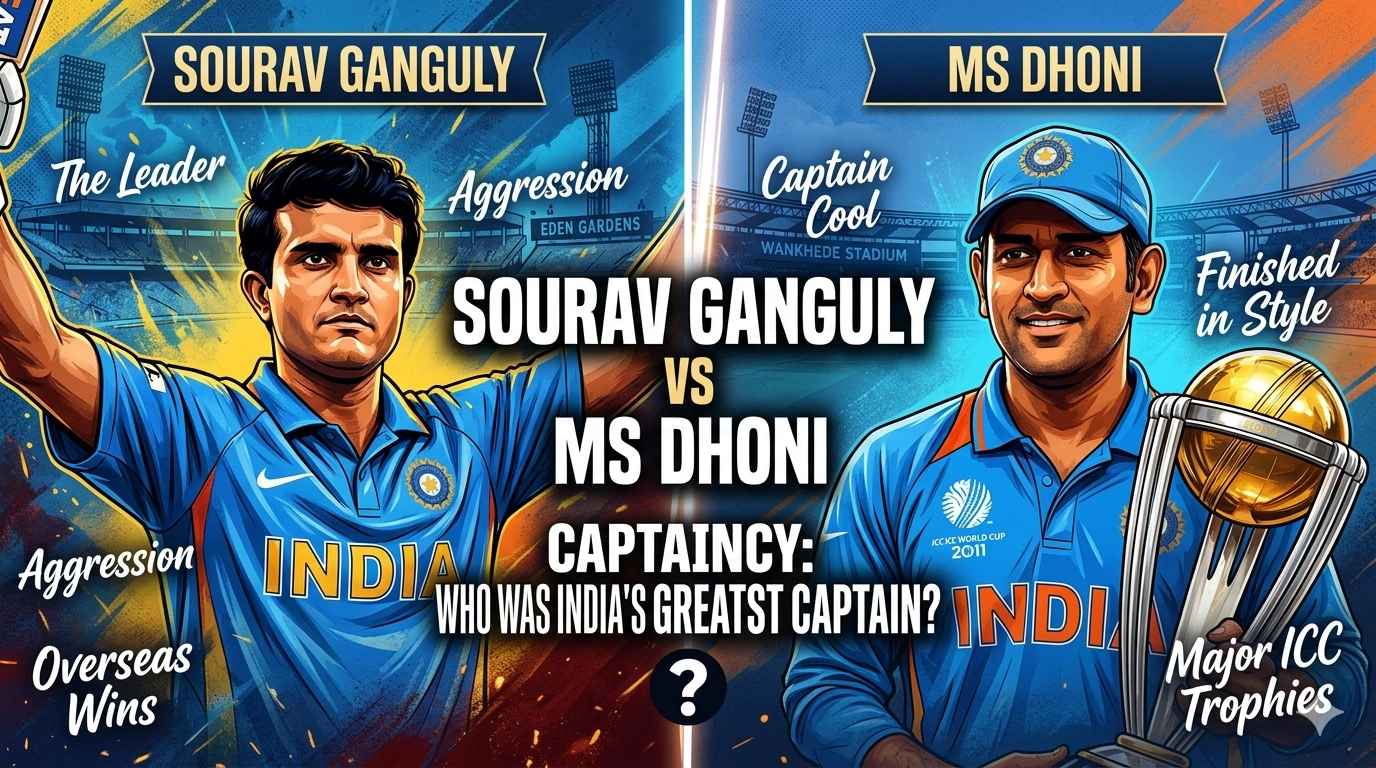
Two captains. Two completely different eras. Two completely different styles. Sourav Ganguly — the fierce, combative Prince of Kolkata who took over a demoralised Indian team in the wake of the match-fixing scandal and rebuilt it from the ground up with aggression, self-belief, and a refusal to be intimidated on any ground in the world. MS Dhoni — the calm, calculating Captain Cool from Ranchi who led India to every major ICC title available to win, across three formats, across a decade of dominance that the game had never seen from a single captain before.
Ganguly led India in 49 Tests winning 21, and 146 ODIs winning 76, transforming a side that struggled overseas into one that could win anywhere. Dhoni led the Indian squad to victory in the 2007 ICC World Twenty20, the 2011 Cricket World Cup, and the 2013 ICC Champions Trophy, becoming the only captain to win three different limited overs ICC tournaments. The numbers point in different directions. The debate has never been settled. This article examines every dimension of both captaincy careers — and tries to get closer to an answer.
The Context Behind Each Captaincy
Ganguly: Picking Up the Pieces
When Sourav Ganguly took over the Indian captaincy in 2000, he inherited a team in crisis. The match-fixing scandal had just broken — Mohammad Azharuddin had been banned for life, Ajay Jadeja had been suspended, and the dressing room’s trust in itself had been shattered. Indian cricket’s reputation, both domestically and internationally, was at its lowest ebb in living memory. The nation’s best players — Tendulkar, Dravid, Kumble — were brilliant individuals but had never been part of a team that believed it could win consistently away from home.
Ganguly changed that. He did not just restore India’s credibility — he fundamentally altered the team’s self-image. Under his captaincy, India became a side that opponents feared, not just respected. He introduced an aggressive culture of non-deference to opposition intimidation, and he backed a generation of young talent — Yuvraj Singh, Zaheer Khan, Harbhajan Singh, Mohammad Kaif, Virender Sehwag — who would go on to form the backbone of India’s next great team.
Dhoni: Inheriting the Foundation
MS Dhoni became India’s T20I captain in 2007 — effectively dropped into the captaincy role at the inaugural World Twenty20 because the senior players had withdrawn from the tournament. He won it. He was then appointed ODI captain, and eventually Test captain. He inherited a team that Ganguly had built and that Dravid and Kumble had continued to develop — a team with genuine self-belief, a settled batting order, and a world-class spin attack.
What Dhoni brought to this team was something different: a preternatural calmness under pressure, a tactical intelligence that expressed itself in quiet match-day decisions rather than pre-match declarations, and a sixth sense for reading what a game needed at a given moment. He did not fire India up the way Ganguly had — he steadied them. And in the formats where his steadiness was most useful, India won everything there was to win.
Ganguly: India’s Most Successful Overseas Test Captain of His Era
Ganguly was the most successful overseas Test captain with 11 wins on foreign soil before Virat Kohli surpassed him with 16 wins. He became the first Indian captain to win a Test series in Pakistan in 2004. The 2003–04 Border-Gavaskar Trophy in Australia ended 1–1 — a result that felt like a victory for India given the strength of the Australian team at the time.
Dhoni: India’s First No. 1 Test Team
Under his captaincy, India achieved the number one spot in the ICC Test Rankings for the very first time. India achieved the milestone after beating Sri Lanka in the home series in 2009. India held the number one spot for nearly 18 months before the overseas collapses in England and Australia brought it to an end. His record of 27 Test wins was, at the time of his retirement, an Indian record.
Dhoni: The Greatest ODI Captain India Has Ever Had
Of the 200 ODIs that India played under Dhoni’s captaincy, they won 110 and lost 74. Only Ricky Ponting (230) and Stephen Fleming (218) have led a team in more ODIs than Dhoni. His 110 wins remains an India record, and his 59.52% win rate in ODIs is the best of any long-serving Indian ODI captain. He won the 2011 World Cup with the six that ended 28 years of hurt, and the 2013 Champions Trophy to complete the set.
Ganguly: 2002 NatWest Trophy and 2003 World Cup Run
In 2002, Yuvraj and Kaif pulled off an upset win over England in the final of the NatWest Trophy. In the 2003 ODI World Cup, Ganguly led India to the final. India won all its matches in the series, except against the eventual champions Australia. Ganguly’s 2003 World Cup campaign — losing only to the eventual champions — remains one of the finest ODI tournament runs by an Indian captain who did not lift the trophy.
The 2007 T20 World Cup — Where Dhoni’s Legend Began
India went into the inaugural T20 World Cup with a young, inexperienced side and Dhoni as a captain who had not led in a major tournament before. The T20 format was new and he was asked to represent the national team in the inaugural world tournament, leading a bunch of promising young players. He set the tone for his captaincy career by winning the T20 World Cup, where they had only lost one game to New Zealand in the league stage before the victory against Pakistan in the final. That victory transformed Indian cricket’s relationship with the shortest format and set the template for CSK’s IPL dynasty that followed.
The Format Ganguly Never Played
Sourav Ganguly retired from international cricket in 2008 — the same year the IPL began and one year after the first T20 World Cup. He never played a T20 International for India, which means any comparison in this format is impossible. Ganguly’s captaincy era predates the format entirely. It is important to acknowledge that Dhoni’s T20 record, impressive as it is, is not directly comparable because Ganguly simply was not there to compete in it.
Ganguly — ICC titles & finals
Dhoni — ICC titles & finals
Dhoni: The Only Captain to Win All Three ICC Limited-Overs Titles
Dhoni led India to victory in the 2013 ICC Champions Trophy and became the first and the only captain in international cricket to claim all ICC limited overs trophies. The T20 World Cup (2007), the ODI World Cup (2011), and the Champions Trophy (2013) — all won under one captain — is an achievement that no other player in history has matched, and that places Dhoni in a captaincy category entirely of his own in white-ball cricket.
Ganguly: The Champion who Reached Three Finals
Ganguly appeared in three major ICC tournament finals as captain — the 2000 Knockout Trophy, the 2002 Champions Trophy (which he shared after the final was washed out), and the 2003 World Cup final. Ganguly formed a new Indian team by nurturing young talents and led India to the final of the ICC Knockout Trophy in 2000, won the NatWest Trophy in 2002, and shared the Champions Trophy with Sri Lanka in 2002. His consistent ability to reach finals demonstrates that his teams were competitive — even if, unlike Dhoni, he did not win all of them outright.
The Verdict
In terms of silverware and statistical dominance, Dhoni is the most decorated Indian captain in history — three ICC titles, 110 ODI wins, the only captain to win all three ICC limited-overs formats, and the first to take India to the top of the Test rankings. By pure numbers and trophies, his case is overwhelming.
But the debate is not purely about trophies. Ganguly’s legacy is the belief he created. He took a broken team and made it fearless. His 11 overseas Test wins were the most any Indian captain had achieved when he retired. He reached three ICC finals in five years — and he did it while rebuilding an entire team’s identity from scratch after the darkest period in Indian cricket’s history.
Ganguly wins in…
Overseas Test wins, cultural transformation, team rebuilding from crisis, producing the next generation, and raw fearlessness as a leader.
Dhoni wins in…
ICC titles (3), ODI win rate, total wins, T20 captaincy, No. 1 Test ranking, and the unique triple of all three limited-overs ICC trophies.
Test Captaincy: The Longest Argument
In Tests, the gap between the two men is narrower than it appears. Ganguly led India in 49 Tests out of which India won 21 and lost 13, with a win percentage of 42.85. Dhoni captained India in 60 Tests out of which India won 27 and lost 18, a win percentage of 45. The win rates are remarkably close — barely two percentage points separate them. But the number that matters most in this format, and that is most often cited in Ganguly’s favour, is the overseas win record.
Ganguly won 11 Test matches outside India — a record for an Indian captain at the time, surpassed only later by Virat Kohli. Dhoni won just 6 overseas Tests in his 60-match Test captaincy. This is the sharpest statistical divergence between the two, and it reflects something real about their respective teams’ ability to compete in SENA countries. Under Ganguly, India won in England, in the West Indies, in Pakistan, and drew in Australia. Under Dhoni, India suffered a painful 4-0 whitewash in England and an 0-4 series loss in Australia in the same calendar year — a collapse that remains one of the most damaging periods in recent Indian Test history.
Against this, Dhoni’s advocates correctly point out that he led India to the top of the ICC Test rankings for the first time in history, and that his overall Test win-loss ratio of 1.5 (27 wins, 18 losses) was strong by India’s historical standards. The argument about overseas Tests, they argue, reflects team composition more than captaincy quality.
ODI Captaincy: Where Dhoni Towers
In ODIs, the comparison is less competitive. Dhoni is simply in a different class as an ODI captain, and the numbers make that clear. His 110 wins from 200 matches at a 59.52% win rate is the best record of any long-serving Indian ODI captain. He won the 2011 World Cup — ending India’s 28-year wait for the title — with a six that has since become one of cricket’s most iconic images. He won the 2013 Champions Trophy, completing a set of ICC trophies that no captain in history has matched.
Ganguly’s ODI captaincy record is far from poor. His 76 wins from 146 matches at 53.52% represents good work, and his 2002 NatWest Trophy win and 2003 World Cup final appearance show a team that could perform in big moments. But against Dhoni’s ODI record, it simply cannot compete. The gap in both quantity of wins and quality of outcomes is too wide to bridge.
The Overseas Test Debate: Ganguly’s Strongest Argument
India’s most successful Test captain overseas, winning 11 out of 28 matches that Ganguly led. That statistic remains central to any honest comparison of these two captains. The context matters here: Ganguly was leading a team that had traditionally struggled overseas, against sides that were often stronger than India on their home conditions. Australia in 2003–04, England in 2002, Pakistan in 2004 — these were competitive series wins or draws achieved through genuine quality and belief.
Dhoni’s overseas Test record is a legitimate weakness in his captaincy CV. The 2011–12 season, when India lost 4-0 in both England and Australia, was the most damaging period of his leadership. The loss of the number one ranking that followed those tours exposed a team that had been allowed to age without adequate succession planning — a failure that could reasonably be attributed to the captain as well as the selectors.
Ganguly’s advocates use this contrast to argue that the Prince of Kolkata was the superior Test captain, even if the overall statistics do not fully reflect it. The counterargument is that Dhoni’s team won more Tests overall, reached the top of the world rankings, and produced memorable home Test victories — including the first-ever Indian whitewash of Australia in a home series in 2013. Both arguments have real merit.
Leadership Style: Fire vs Ice
As leaders, Ganguly and Dhoni could hardly have been more different, and both styles worked. Ganguly led with emotion, confrontation, and an externally projected confidence that communicated itself to the opposition as much as to his own team. He stared down Australian sledging. He ripped off his shirt at Lord’s. He told the world that India were coming, and then he brought a team with him that made it true. His captaincy was personal, passionate, and deeply connected to Indian cricket’s need to reclaim its dignity after the match-fixing years.
Dhoni led with logic, composure, and an almost uncanny ability to detach himself from pressure. In the 2011 World Cup final, with India needing 91 from the last 120 balls and the match perfectly poised, Dhoni promoted himself ahead of in-form Yuvraj Singh. He made 91 not out. That decision — made in the calmest imaginable manner — is a perfect encapsulation of his captaincy: trusting his own judgement completely, unbothered by convention, and right. He also used the DRS — the Decision Review System — with such accuracy that it became informally known as the “Dhoni Review System” among commentators and fans.
Talent Identification and Nurturing
Both captains identified and backed young talent with remarkable effectiveness. Ganguly’s record in this regard is exceptional: he gave early opportunities to Yuvraj Singh, Zaheer Khan, Harbhajan Singh, Virender Sehwag, Mohammad Kaif, and MS Dhoni himself — players who went on to define Indian cricket for the next decade. Ganguly effectively built the team that Dhoni would go on to captain. That is a legacy that deserves considerable credit in any comparison.
Dhoni, for his part, backed players at crucial moments — promoting himself in that World Cup final, backing Suresh Raina in pressure situations, trusting Ravindra Jadeja’s worth before most others could see it. His ability to identify what a particular match situation needed, and to pick the right player to deliver it, was one of his most celebrated qualities. He also managed India’s transition from the Tendulkar-Dravid-Ganguly generation to the Kohli-Sharma-Jadeja generation with considerable skill.
Legacy: What They Built for Indian Cricket
Ganguly’s legacy is the culture he created. Before him, Indian cricketers were known to be technically excellent and mentally fragile when the pressure was greatest and the conditions were unfamiliar. After him, they were known as fighters — aggressive, confident, and capable of winning on any ground in the world. Nobody can dispute that he was India’s most successful Test captain — forging a winning unit from a bunch of talented, but directionless, individuals. The foundations he laid made everything that followed possible.
Dhoni’s legacy is the trophies — and the manner in which he won them. Under Dhoni’s leadership, India won the top prize in all formats: leading the Test rankings for 18 months starting December 2009, winning the 50-over World Cup in 2011, and the T20 world title on his captaincy debut in 2007. No other captain has done what Dhoni did across three formats. His 5 IPL titles with Chennai Super Kings are a separate chapter of captaincy excellence that extends the argument beyond international cricket entirely.
After cricket, both men moved into administration. Ganguly became BCCI President in 2019, continuing to shape the game he had transformed as a player. Dhoni continued playing IPL cricket with CSK, remaining one of the most influential figures in the game even in retirement. Their influence on Indian cricket did not end when their captaincy did — it continues, in different forms, to this day.
Also Read- Kapil Dev vs Imran Khan