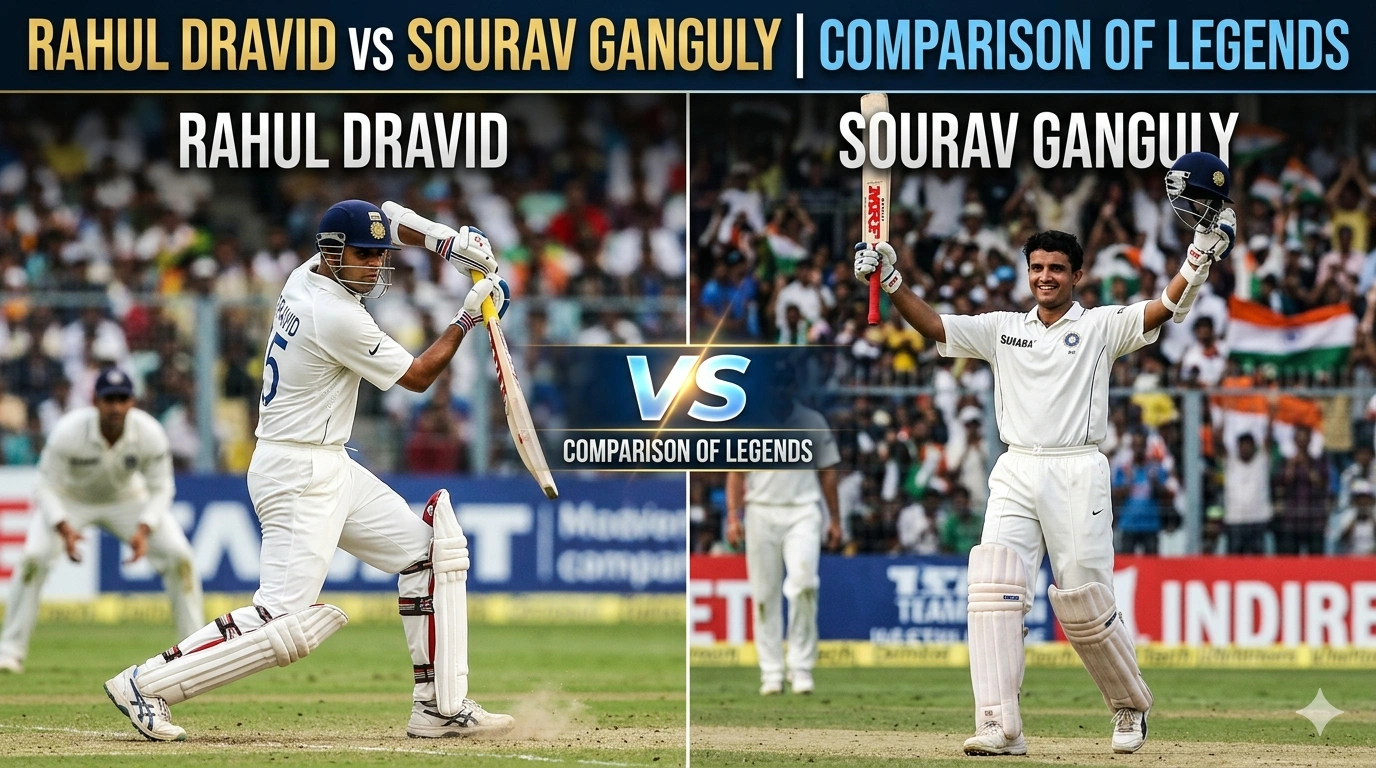
Two Indians. One dressing room. Completely opposite personalities. Rahul Dravid — the meticulous, unbreakable Wall who batted as if every innings was a personal war of attrition against the world’s best bowlers. Sourav Ganguly — the imperious, wrist-flicking Prince of Kolkata who walked onto every ground and made it feel like he owned it. Together, alongside Tendulkar and Laxman, they formed the greatest batting unit India had ever assembled.
But how do they compare individually? Dravid’s numbers in Test cricket are staggering — 13,288 runs, 36 centuries, an average above 52, all accumulated through sheer will and perfect technique. Ganguly’s numbers tell a different story — a fearless captain who rebuilt Indian cricket’s culture, a match-winner in coloured clothing, and a batter who produced his finest hours when the pressure was greatest. This article settles nothing — but it examines everything.
The Rise of Two Legends
Rahul Dravid: Bangalore’s Quiet Genius
Rahul Sharad Dravid made his Test debut at Lord’s in June 1996 and scored 95 — a breathtaking innings from a debutant, against a quality England attack, in the most demanding conditions Test cricket offers. The only reason people remember Ganguly’s debut more from that same match is because Ganguly scored 131. But those two innings, on the same day, at the same ground, in the same team, were a perfect metaphor for everything that followed: Dravid brilliant but overshadowed by Ganguly’s flourish.
What set Dravid apart almost from the beginning was his extraordinary concentration and technical purity. His defence was essentially impenetrable — he could bat for eight hours without appearing to tire, and he could do it in Chennai heat, in English swing, in Australian bounce, and on Pakistani turning tracks. He finished with 210 catches in the field — an all-time Test world record — and five double centuries, each of them match-defining performances that rescued India from trouble.
Sourav Ganguly: Kolkata’s Maharaja
Sourav Chandidas Ganguly arrived in Test cricket in the same game as Dravid, at the same ground, and scored a century on debut. That was the moment India’s cricketing public fell in love with him — the easy elegance through the off side, the whiplash wrist through mid-wicket, the arrogance of someone who had absolutely no intention of being intimidated by the occasion or the opposition.
But Ganguly’s greatest contribution to Indian cricket was not his batting. It was his captaincy, and the transformation of India’s self-belief as a team. He took over the captaincy in 2000 in the wake of the match-fixing scandal — arguably the darkest moment in Indian cricket’s history — and rebuilt the team’s culture from the ground up. He identified young talent, backed aggression over caution, and told India’s cricketers, in no uncertain terms, that they were capable of winning anywhere in the world. The results proved him right.
Dravid’s 270 at Rawalpindi — India’s Greatest Overseas Test Innings
In the third Test against Pakistan in 2004, Dravid batted for more than 12 hours to score 270 — his career-best — and set up India’s first series win on Pakistani soil. It was an innings of almost superhuman concentration and stamina, and remains one of the greatest individual Test performances by an Indian batter overseas.
183 at Taunton — Ganguly’s Greatest ODI Innings
In the 1999 World Cup against Sri Lanka, Ganguly smashed 183 off 158 balls — the highest individual score by an Indian in World Cup history, and at the time the second-highest score ever in a World Cup match. His partnership of 318 with Dravid remains the highest World Cup partnership of all time, and was the first 300+ run partnership in ODI history.
Dravid the Wicketkeeper: Ganguly’s Masterstroke
For a significant portion of his ODI career, Dravid kept wicket to allow an extra specialist batter in the eleven. This was Ganguly’s tactical innovation as captain — asking his best Test batter to don the gloves so India could field a more balanced batting lineup. Dravid accepted without complaint, and India reached the 2003 World Cup final in part because of it.
Ganguly: India’s Most Transformative Captain
When Ganguly took over the captaincy in 2000, India had just been rocked by the match-fixing scandal. He rebuilt the team’s culture, fearlessness and self-belief from scratch. He identified and backed Yuvraj Singh, Harbhajan Singh, Zaheer Khan, and MS Dhoni — the core of India’s next generation of champions. His 2003 World Cup final appearance and the 2002 Champions Trophy title were the crowning moments, but the greater legacy was the attitude shift he created.
Dravid: India’s First Overseas Series Winner in a Generation
Dravid led India to historic series wins in the West Indies (2006) and England (2007) — the first time India had won in England in 21 years. While his Test captaincy record is modest in terms of win rate, those two overseas series wins represent genuine turning points in India’s cricketing identity as an away team.
Lord’s 1996 — Two Legends Born on the Same Day
In one of the most remarkable coincidences in cricket history, Dravid and Ganguly both made their Test debuts on the same day at Lord’s. Ganguly scored 131, Dravid scored 95. India won by nobody’s expectation. Both men were clearly Test-quality batters from their first appearances — but they arrived with completely different energies. Ganguly imperious, Dravid disciplined. It was a perfect preview of their entire careers.
1999 World Cup — The 318-Run Partnership
Against Sri Lanka at Taunton, Ganguly (183) and Dravid (145) put on 318 runs together — the first 300+ partnership in ODI history, and the highest World Cup partnership ever. It was one of the most dominant days either player ever had in coloured clothing, and it showcased how complementary they were: Ganguly blazing, Dravid accumulating with precision. India won by 157 runs.
Eden Gardens 2001 — Dravid the Anchor
In the most famous Test match India ever played — the miracle of Eden Gardens when India followed on 274 runs behind against Australia — Dravid batted for 180 overs across both innings. His 180 in the second innings alongside Laxman’s 281 was the partnership that changed Indian cricket history. Ganguly, as captain, made the bold declaration. Dravid, as batter, made it possible.
2002 Champions Trophy — Ganguly’s Finest Hour as Leader
Ganguly led India to the Champions Trophy title jointly with Sri Lanka — India’s first major ICC trophy since 1983. His captaincy throughout the tournament was bold, tactically sharp, and inspirational. Dravid was a key member of that squad, and the bond between the two men — despite occasional friction — was central to what India achieved throughout this era.
The Ganguly–Chappell Controversy (2005) — Dravid Steps Up
When the Greg Chappell email controversy led to Ganguly’s removal from the captaincy, Dravid stepped in as captain. It was an uncomfortable transition — Dravid and Ganguly had different personalities and the broader team dynamic was complex. Dravid handled the situation with his characteristic dignified composure, going on to lead the side to the England series win in 2007, one of his finest moments as captain.
The Verdict
In pure batting statistics — volume, average, centuries and longevity — Dravid wins clearly. His 13,288 Test runs and 52.31 average are marks of an all-time great. In terms of cultural impact, captaincy legacy and rebuilding India’s identity as a fearless cricket nation, Ganguly’s argument is compelling and perhaps unanswerable.
One built India’s results. The other built India’s belief. Both were irreplaceable.
The Wall wins in…
Test runs, average, centuries, longevity, fielding record, overseas consistency. The greatest Indian Test batter not named Tendulkar.
Dada wins in…
Captaincy wins, ODI centuries, cultural transformation, fearlessness under pressure, and rebuilding Indian cricket’s identity abroad.
Batting Style and Technical Brilliance
Dravid: The Art of Staying In
To watch Rahul Dravid bat at his best was to understand that batting in Test cricket is not about scoring runs — it is about not getting out. His technique was almost academic in its correctness: head still, bat straight, weight transferred, nothing wasted. He had five double centuries in Tests, each of them a statement of concentration so total that opposition bowlers reportedly ran out of ideas against him. His footwork against spin was exceptional; his judgement of the outswinger among the finest ever seen.
The misconception about Dravid is that he was dull. Watch the 270 at Rawalpindi, the 180 at Eden Gardens, the 146 at The Oval in 2011 — his last Test innings in England, at the age of 38. These were not passive performances; they were acts of controlled aggression, executed over long hours, that broke the spirit of the bowling attacks directed at him. Dravid did not play for the crowd. He played for the result.
Ganguly: The Wrist and the Will
Ganguly’s batting was built around two things: an extraordinary set of hands through the off side, and a will to dominate that he never attempted to conceal. His cover drive was as beautiful as any in the modern game — languid, late, and devastating. Through mid-wicket his wrists were whip-sharp. He was less comfortable against short-pitched bowling on the body, a weakness that opponents identified and exploited, but even then his response was rarely technical — it was psychological. He fought back.
In ODIs, Ganguly was arguably the more natural match-winner. His 22 centuries in the format came in all conditions, against all teams, and many of them at crucial moments in tournaments and chases. His 183 in the 1999 World Cup stands as one of the finest ODI innings ever played by an Indian batter. In Tests, his best work often came when India needed someone to put the opposition under pressure quickly — which was a different art from Dravid’s, but equally necessary.
Captaincy: How They Led India
This is the section where Ganguly separates himself most clearly from his great contemporary. Ganguly is widely regarded as the most transformative captain in Indian cricket history — not just the most successful in terms of results, but the most important in terms of changing what India believed was possible. He took a team traumatised by the match-fixing scandal and rebuilt it as one of the most feared sides in world cricket within three years.
His key innovations as captain are well-documented: using Dravid as wicketkeeper to accommodate extra batting depth, giving young players immediate backing rather than letting them be eased in, playing aggressive cricket away from home rather than defending, and standing up to bullying from opposition players in a way that no Indian captain before him had. When he took off his shirt and waved it at Wankhede to celebrate beating Pakistan in the NatWest Trophy final in 2002, it was not just celebration — it was a statement about the new India.
Dravid’s captaincy was more understated but genuinely significant. He led India to Test series wins in the West Indies and in England — the latter for the first time in 21 years. His calm, analytical style was in some ways the opposite of Ganguly’s fire, but it worked because the team he inherited was confident and talented. He was a good captain in difficult circumstances. Ganguly was a great captain who created the circumstances.
Their Partnership: Better Together
One of the most underappreciated aspects of the Dravid–Ganguly story is how often they made each other better. The 318-run partnership in the 1999 World Cup against Sri Lanka was the most visible example, but it was one of dozens. In Tests, they put on important stands repeatedly — Ganguly providing momentum, Dravid providing anchor. In ODIs, Ganguly at the top of the order and Dravid in the middle offered India a balance that made them hard to beat.
They were not always comfortable together. Their temperaments were almost diametrically opposed: Ganguly external, emotional, confrontational; Dravid internal, analytical, dignified. When the Chappell controversy erupted in 2005 and Ganguly was effectively pushed out of the team, the dressing room tension was palpable. Yet both men handled the situation with a degree of professionalism that ultimately allowed them to coexist and, eventually, succeed together again.
Legacy: What Indian Cricket Owes Them
The India that won the 2007 T20 World Cup, the 2011 ODI World Cup, and eventually the 2023 and 2024 ICC events was built, in part, on the foundations that Ganguly and Dravid laid in the early 2000s. Ganguly built the culture and the confidence. Dravid built the coaching pathway — he went on to coach India’s Under-19 team, the India A team, and ultimately the senior Indian team to the 2024 T20 World Cup title. His post-playing career as a coach has arguably made him as influential as his playing career.
Ganguly, meanwhile, became BCCI president in 2019 and brought the same directness and conviction to cricket administration that he had brought to captaincy. Day-night Test matches in India, infrastructure improvements, and a continued push for India to compete fearlessly anywhere — these were his administrative priorities, and they echoed his playing philosophy perfectly.
What Indian cricket owes these two men cannot be calculated in runs or wickets. It owes them the belief that it was possible to be a great team, not just a team with great individuals. That belief, more than any statistic, is the most durable part of their legacy.
Also Read- Rahul Dravid vs VVS Laxman